
Archimedes Semiconductor Secures Hundreds of Millions in Angel Round: Diamond Integrated into SiC Modules for the First Time
Published:
Reposted by Newlife - MIM, original copyright belongs to the author; the original link is available in the "Sources" section at the end.
Recently, Wuhan Archimedes Semiconductor has completed an angel round of financing amounting to hundreds of millions of RMB.
The list of investors is both extensive and heavyweight: Sungrow, CATL, Xiaomi, Zhongyin Fashion, Changjiang Industrial Investment, Wuhan High-Tech, Wuhan Venture Capital, and Gupo Fund. Half of them are industry leaders, while the other half consist of local state-owned capital and professional institutions.
The company was established in January this year as the Central China platform for Archimedes Semiconductor (Hefei). It was jointly initiated by the Hefei entity and leading customers such as Sungrow. It officially opened on April 20, and its registered capital was recently increased from 10 million RMB to 13.494 million RMB on November 3. Instead of engaging in the conventional power device business, the company focuses on diamond materials and embedded architectures. It is specifically designed to address the increasingly demanding power density and thermal management requirements of high-performance AI computing and power electronics, thereby promoting collaborative innovation across materials, packaging, and device architectures. According to the company's own statements, the goal is to break through the performance boundaries of traditional materials and packaging technologies. It has launched the nation's first "Diamond Inside" silicon carbide (SiC) power module and has already delivered it to electric aircraft customers. Its service targets span the AI industry chain (AIDC, optical modules, AI terminals) on one end, and the power industry chain (new energy vehicles, optical storage and charging, embodied intelligence, low-altitude aircraft) on the other.
01 Heat is Pushing the Limits of Packaging
Let us first look at the numbers on the demand side. According to eet-china.com, the power consumption of a single NVIDIA H100 graphics card is approximately 700W, while the B300 approaches 1400W. The next-generation Rubin architecture is expected to exceed 1500W, with some industry sources pointing to a staggering 2300W per single chip. The power consumption of a single cabinet for AI servers has generally surpassed 120kW, whereas the effective upper limit of traditional air cooling is merely 20 to 50kW per cabinet.
This means that liquid cooling has become a mandatory option. However, liquid cooling only solves the problem of "moving the heat away"; it cannot solve the issue of "heat failing to spread evenly within the chip." Chips do not generate heat uniformly. The local heat flux density of computing modules, SerDes, and power supply areas can be several times the average value. The lateral thermal conductivity of copper heat spreaders, which is 400W/m·K, is no longer sufficient to flatten these intense heat peaks.
This is precisely why diamond is being brought to the forefront. The room-temperature thermal conductivity of diamond is 2000-2200W/m·K, which is 5 times that of copper and 8 to 10 times that of aluminum. Its coefficient of thermal expansion is about 1ppm/K, which is much closer to silicon than copper. Moreover, as an electrical insulator, it can be placed directly against the chip without any risk of short circuits.
Industrial actions have become so dense that predictions are no longer necessary. In February this year, NVIDIA confirmed that the next-generation Vera Rubin architecture will adopt a "diamond-copper composite heat spreader cover + 45℃ warm water direct liquid cooling" solution, transitioning into a fully liquid-cooled, fanless scheme. In the same month, Akash Systems delivered the world's first batch of diamond-cooled H200 servers to India's sovereign cloud. Actual tests showed that the GPU and HBM temperatures dropped by 10%, energy efficiency improved by 22%, and computing power throughput in high-temperature environments increased by 15%. In March, the company also completed the adaptation for the AMD MI350X platform. Domestically, in April, the Zhengzhou core node of the National Supercomputing Internet applied diamond-copper composite materials on a large scale for the first time. The heat transfer capacity of the chip module increased by 80%, performance improved by 10%, and the operating temperature dropped by 5℃.
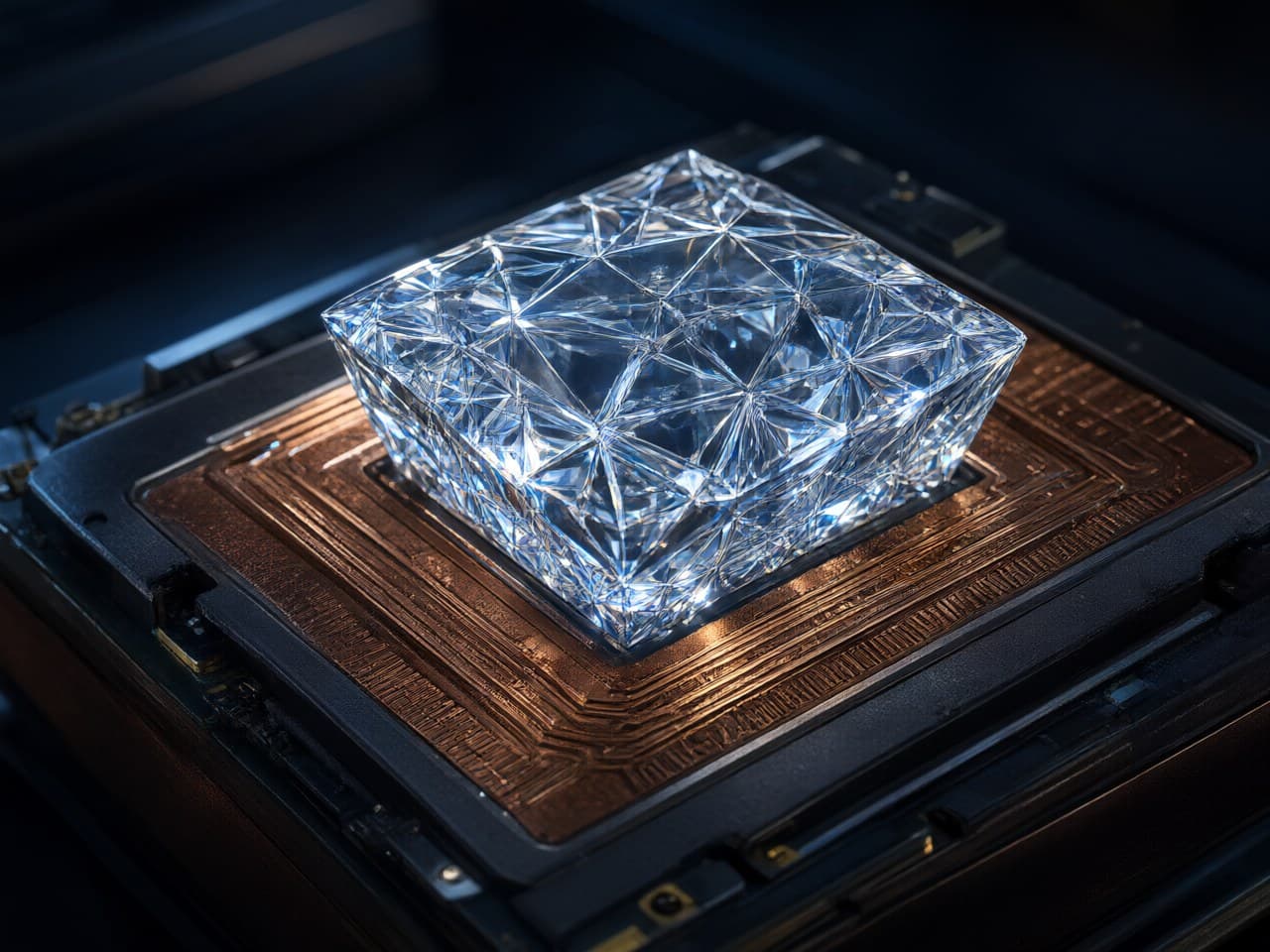
However, it is crucial to note that all the above applications occurred outside the packaging or directly on the packaging surface. Cold plates, cover plates, and heat sink pads are essentially "add-ons." What Archimedes intends to do is to embed diamond composites deep inside the module, making the packaging structure itself an integral part of the heat dissipation architecture.
02 From "A Material Costing Tens of Thousands per Wafer" to "The Right to Define a Module"
Attaching a piece of diamond heat sink pad rigorously tests the surface roughness, warpage, and metallization process. Guoji Diamond controls the warpage of 4-inch heat sink pads to within 10 microns and achieves a nanometer-level surface finish before it can even be considered practically attachable.
Embedding diamond into the module, however, requires simultaneously handling the thermal resistance superposition of three complex interfaces: chip-diamond, diamond-solder, and solder-substrate. It requires managing the mechanical stress caused by the expansion mismatch of different materials under severe thermal cycling. Furthermore, the entire structure must pass long-cycle reliability verification for demanding scenarios such as automotive standards, energy storage, and AIDC power supply. The publicly disclosed technical indicators by Archimedes include a 40% reduction in module thermal resistance, a 30% reduction in system-level weight, and full compatibility with existing industry-standard packaging systems. If these three metrics can be stably reproduced on customers' production lines, the nature of the business fundamentally changes: it shifts from merely selling materials to actively participating in the definition of the module.
And this company did not come to this task empty-handed. The Hefei entity was established in 2021. The core team hails from industry giants such as Infineon, onsemi, Huawei, Mitsubishi, and Vincotech. Co-founder Liu Sheng is an academician of the Chinese Academy of Sciences. His leading project, "Key Technologies and Complete Processes for High-Density and High-Reliability Electronic Packaging," won the First Prize of the National Science and Technology Progress Award. The three SiC/IGBT production lines in Hefei have been put into mass production, boasting an annual capacity of 600,000 automotive-grade modules, 800,000 optical storage and charging modules, and 12 million discrete devices. Additionally, an annual production line of 500,000 SiC plastic-encapsulated modules has been successfully commissioned. In the first half of 2026, it secured a designated project for Sungrow's main optical storage project. Automotive-grade modules are installed in vehicles from Liuzhou Motor, SAIC Hongyan, and FAW Jiefang, and project cooperation has been established with leading passenger car enterprises.
The foundation for packaging technology is already fully in place; what is missing is the engineering of the new diamond process. This also explains why it is the "module manufacturer" rather than the "material manufacturer" taking the lead in this endeavor.
03 How to Read the Shareholder List
Sungrow was one of the earliest investors to enter, completing its investment by the end of March. It serves as both a strategic shareholder and the second-largest shareholder of Archimedes. The two parties have jointly developed packaging topology solutions since the very early chip definition stage. This corresponds to scenarios such as optical storage, charging, and source-grid sides, which are extremely sensitive to efficiency, volume, and lifespan. It is also Archimedes' largest current customer base in terms of shipment volume.
CATL invested in October, holding approximately 4% of the shares, corresponding to power batteries, energy storage systems, and electric drives. As energy storage moves towards larger capacity and longer discharge durations, thermal management directly determines the system's overall lifespan. The logic for AIDC power supply is exactly the same.
Xiaomi holds about 2% of the shares, corresponding to automotive electric drives, fast charging, AI hardware, and robotics. Hanxing Venture Capital has intensively deployed in chips, three-electric systems, embodied intelligence, and battery swap facilities over the past two years. Xiaomi Auto itself also holds a number of patents related to motor controllers and power modules, with the direction precisely focusing on heat dissipation and output capability.
Looking at the three together, they cover the four main lines of high-power hardware: electric drives, energy storage, AIDC power supply, and AI terminals. What they are buying is not diamond capacity, but the strategic right to control the thermal dissipation layer within their own systems.
04 The Material Side is Accumulating; the Watershed Will Shift to Packaging
On the diamond industry chain, capacity expansion on the material side is progressing much faster than initially imagined. According to eet-china.com, Guoji Diamond has formed an annual production capacity of over 40,000 3-inch diamond heat dissipation wafers. It has fully deployed three technological routes: single crystal, polycrystal, and diamond-copper. Polycrystalline heat sink pads are delivered in batches, and diamond-copper is supplied stably in batches. Huanghe Whirlwind commissioned the country's first 8-inch diamond heat sink pad line in February, with an annual capacity of 20,000 pieces. It plans to equip 300 MPCVD units within three years to produce 150,000 large-size heat sink pads annually. SFD's diamond heat dissipation pads have a thermal conductivity of over 2000W/m·K and have entered the supply chain of leading customers. In April, it invested 450 million RMB to build a 25,000-piece CVD production line in Shaya. Worldia has delivered 12-inch diamond heat dissipation wafers, compatible with 50-300mm wafers. Power Diamond changed its 1.028 billion RMB fundraising in June to invest heavily in diamond functional material projects.
Once the material supply is scaled up, the watershed of industry competition will inevitably shift from "who can grow diamond" to "who can integrate it into packaging." The price elasticity of heat dissipation materials is limited; the design right of the packaging structure is the true source of long-term profits. This is also why, in this current cycle, module manufacturers are standing in the foreground.
The market space provides a sufficient time window for this judgment. Zhongtai Securities forecasts that the global diamond heat dissipation pad market for high-end AI chips will reach approximately 870 million RMB in 2026 and about 5.92 billion RMB in 2030, representing a compound annual growth rate of over 50%. Huafu Securities estimates that the diamond heat dissipation space for AI computing power will reach between 48 billion and 90 billion RMB in 2030. Founder Securities defines 2026 as the inaugural year of commercialization, with a penetration rate of about 1%, which is projected to rise to 12%–20% by 2030. Soochow Securities, calculating based on the overall liquid cooling market scale, estimates that the diamond heat dissipation market will reach approximately 5.4 billion USD in 2030 under a neutral scenario. The penetration rate curves all show a pattern of "slow at first, then fast," and the period from 2026 to 2030 is exactly that critical climbing window.
Conclusion
The significance of this round of financing lies not in the fact that another company has received money, but in the fact that diamond has finally transformed from an "auxiliary material placed next to the chip" into a "component written into the module structure." The former is a materials business; the latter is a semiconductor business.
Sources
- eet-china.com › web (2026-11-10) - Original link: Archimedes: Hundreds of Millions in Angel Round Secured, Diamond Integrated into SiC Modules for the First Time - https://www.eet-china.com/mp/a538230.html