
Nuclear Power in the USA
Published:
Republished by Newlife - MIM. All rights belong to the original publisher; see Source below.
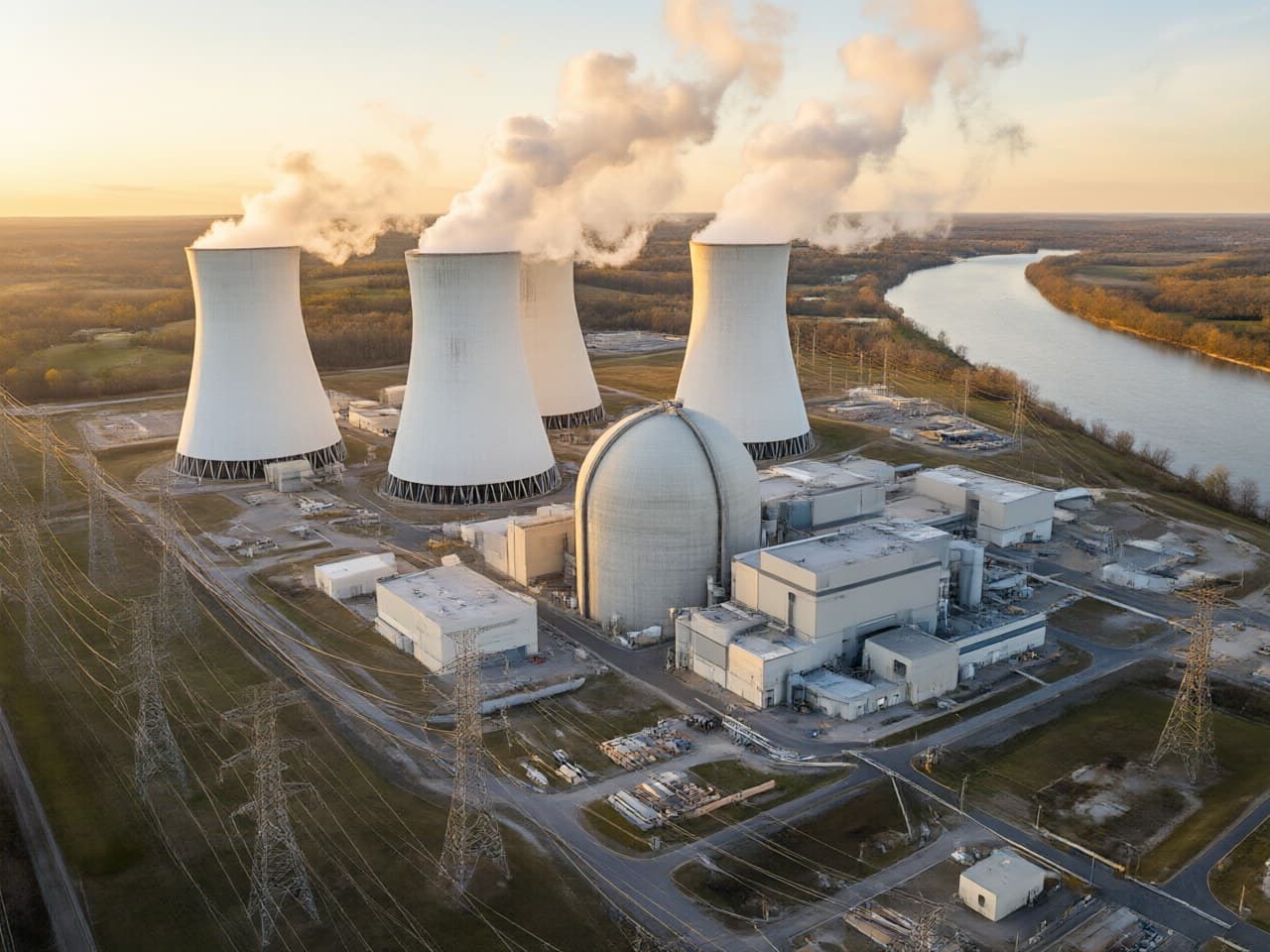
The USA is the world's largest producer of nuclear power, accounting for about 30% of worldwide generation of nuclear electricity. The country's nuclear reactors produced 818 TWh in 2025, 17% of total electrical output. Vogtle 3 was connected to the grid in April 2023, followed by unit 4 in March 2024. The Inflation Reduction Act was signed into law in August 2022. The Act provides support for existing and new nuclear development through investment and tax incentives for both large existing nuclear plants and newer advanced reactors, as well as high-assay low enriched uranium (HALEU) and hydrogen production. Targets to quadruple US nuclear capacity (to 400 GWe) by 2050 and to deploy advanced reactors in the near term were set by the administration in 2025.
94 Operable Reactors 96,952 MWe 0 Reactors Under Construction 0 MWe 41 Reactors Shutdown 20,016 MWe
Electricity sector
Total generation (in 2025): 4703 TWh
Generation mix: natural gas 1865 TWh (40%); nuclear 818 TWh (17%); coal 809 TWh (17%); wind 470 TWh (10%); solar 356 TWh (8%); hydro 273 TWh (6%); biofuels & waste 58.1 TWh (1%); oil 33.9 TWh; geothermal 18.3 TWh.
Import/export balance: 12.4 TWh net import (30.1 TWh imports; 17.7 TWh exports)
Total consumption: 4146 TWh
Per capita consumption: c. 12,100 kWh in 2025
Source: International Energy Agency and The World Bank. Data for year 2025.
Nuclear power industry
Operable reactors in the USA
A table of operable plants in the USA is available as an appendix to this page.
Nuclear power plays a major role in electricity provision across the country. The US fleet is operated across 28 different states. Since 2001 these plants have achieved an average capacity factor of over 90%. The average capacity factor has risen from 50% in the early 1970s, to 70% in 1991, and it passed 90% in 2002, remaining at around this level since. In 2019 it was a record 94%. The industry invests about USD 8 billion per year in maintenance and upgrades of the plants.
Nuclear plants generate about 17% of the country’s electricity overall and are its largest single source of low-carbon electricity, providing more than 40%.
Since about 2010 sustained low natural gas prices dampened plans for new nuclear capacity (see section on New nuclear capacity below). However, in August 2022 the Inflation Reduction Act was passed by the US House of Representatives and later that month signed into law by President Joe Biden. The energy provisions in the Act outline support for existing and new nuclear development through investment and tax incentives for both large existing nuclear plants and newer advanced reactors, as well as HALEU and hydrogen production.
Later, in May 2025 US President Donald Trump signed a series of executive orders designed to stimulate growth in the industry with the aim of quadrupling capacity by 2050 (see section on Presidential executive orders, May 2025 below).
Nuclear industry development
The USA was a pioneer of nuclear power development . a Westinghouse designed the first fully commercial pressurized water reactor (PWR), a unit of 250 MWe capacity, Yankee Rowe, which started up in 1960 and operated to 1992. Meanwhile the boiling water reactor (BWR) was developed by the Argonne National Laboratory, and the first commercial plant, Dresden 1 (250 MWe) designed by General Electric, was started up in 1960. A prototype BWR, Vallecitos, ran from 1957 to 1963.
By the end of the 1960s, orders were being placed for PWR and BWR reactor units of more than 1000 MWe capacity, and a major construction programme got under way. These remain practically the only types built commercially in the USA. b
Almost all the US nuclear generating capacity comes from reactors built between 1967 and 1990. Until 2013 there had been no new construction starts since 1977, largely because for a number of years gas generation was considered more economically attractive and because construction during the 1970s and 1980s had frequently been delayed.
Nuclear developments in USA suffered a major setback after the 1979 Three Mile Island accident , though that actually validated the very conservative design principles of Western reactors, and no-one was injured or exposed to harmful radiation. Many orders and projects were cancelled or suspended, and the nuclear construction industry went into the doldrums for two decades. Nevertheless, by 1990 over 100 commercial power reactors had been commissioned.
A further PWR – Watts Bar 2 – started up in 2016 following Tennessee Valley Authority's (TVA's) decision in 2007 to complete the construction of the unit, and Vogtle 3&4 were connected to the grid in 2023 and 2024 respectively.
Most reactors were built by regulated utilities, often state-based, which meant that they put the capital cost (whatever it turned out to be after, for example, delays) into their rate base and amortized it against power sales. Their consumers bore the risk and paid the capital cost. (With electricity deregulation in some states, the shareholders bear any risk of capital overruns and power is sold into competitive markets.)
Despite a near halt in new construction for more than 30 years, US reliance on nuclear power has grown. In 1980, nuclear plants produced 251 TWh, accounting for 11% of the country's electricity generation. In 2025 output was 818 TWh providing about 17% of electricity. Much of the increase came from the 47 reactors, all approved for construction before 1977, that came online in the late 1970s and 1980s, more than doubling US nuclear generation capacity. The US nuclear industry has also achieved remarkable gains in power plant utilization through improved refuelling, maintenance and safety systems at existing plants. Average nuclear generation costs have come down from USD 55.72/MWh (in 2025 dollars) in 2012 to USD 36.46/MWh in 2025. This 35% reduction in nuclear generating costs since 2012 has been driven by: a 40% decrease in fuel costs; a 36% decrease in capital expenditures; and a 32% decrease in operating costs. 9
Operationally, from the 1970s the US nuclear industry dramatically improved its safety and operational performance, and by the turn of the century it was among world leaders, with average net capacity factor over 90%.
This performance was achieved as the US industry continued deregulation, begun with passage of the Energy Policy Act in 1992. Changes accelerated after 1998, including mergers and acquisitions affecting the ownership and management of nuclear power plants.
Reactor lifetime extensions and regulation
The Nuclear Regulatory Commission (NRC) is the government agency established in 1974 to be responsible for regulation of the nuclear industry, notably reactors, fuel cycle facilities, materials and waste (as well as other civil uses of nuclear material).
In an historic move, the NRC in March 2000 renewed the operating licences of the two-unit Calvert Cliffs nuclear power plant for an additional 20 years. In March 2019 the NRC renewed the licence for Seabrook, extending the unit’s operation by 20 years to 2050. This took the number of US power reactors that have renewed their licences to 94, several of which have since shut down. Hence, almost all of the US power reactors are likely to be licensed to operate for 60 years, with owners undertaking major capital works to upgrade them at around 30-40 years. The licence renewal process typically costs USD 16-25 million, and the procedures for such renewals, with public meetings and thorough safety review, are exhaustive.
The original 40-year licences were always intended to be renewed in 20-year increments, as the 40-year period was more to do with amortization of capital rather than implying that reactors were designed for only that operational lifespan. It was also a conservative measure, and experience since has identified life-limiting factors and addressed them. The NRC is now considering applications for the extension of operating licences beyond 60 out to 80 years, with its subsequent licence renewal (SLR) programme. As of September 2026
Reactors approved (to 80 years): Turkey Point 3&4, Peach Bottom 2&3, Surry 1&2, North Anna 1&2, Monticello, Oconee 1-3, Virgil C. Summer 1, Point Beach 1&2, Browns Ferry 1-3, Dresden 2&3, St. Lucie 1&2, H.B. Robinson 2, Edwin I. Hatch 1&2. Reactors under review: Nine Mile Point 1, Cooper and R.E. Ginna.
In March 2026 Arizona Public Service announced its intention to seek subsequent licence renewal for all three Palo Verde units, with a notice of intent for the application planned for late 2027.
The licence extensions to 60 years and beyond meant that major mid-life refurbishment, such as replacement of steam generators and upgrades of instrument and control systems, could be justified. While active plant components such as pumps and valves are under continuous scrutiny for operability, passive components need to be assessed for ageing which may have weakened them. There are R&D programmes focusing on this run by the Department of Energy (DOE), Electric Power Research Institute (EPRI), and American Society of Mechanical Engineers (ASME).
The NRC's reactor oversight and assessment process yields publicly-accessible information on the performance of plants in 19 key areas (14 indicators on plant safety, two on radiation safety and three on security). Performance against each indicator is reported quarterly on the NRC website according to whether it is normal, attracting regulatory oversight, provoking regulatory action, or unacceptable (in which case the plant would probably be shut down).
On the industry side, the Institute of Nuclear Power Operations (INPO) was formed after the Three Mile Island accident in 1979, to establish standards of performance against which individual plants could be regularly measured. An inspection of each member plant is typically performed every 18 to 24 months.
Following the accident at Japan's Fukushima nuclear plant in March 2011, which was exacerbated by inadequate outside assistance to the flooded reactors, the US nuclear industry set up the 'FLEX' accident response strategy. It has 61 centres across the country and two national centres which together provide the capacity to respond to nuclear power plant accidents anywhere in the country within 24 hours.
In September 2025 the USA and UK signed the Technology Prosperity Deal that deepens collaboration between the NRC and the UK’s Office for Nuclear Regulation (ONR) and Environment Agency to support the completion of reactor design reviews within two years and site approvals within one year.
New nuclear capacity
From 1992 to 2005, some 270,000 MWe of new gas-fired plant was built, and only 14,000 MWe of new nuclear and coal-fired capacity came online. But coal and nuclear supplied almost 70% of US electricity at the time and provided price stability. When investment in these two technologies almost disappeared, unsustainable demands were placed on gas supplies and prices quadrupled, forcing large industrial users of it offshore and pushing gas-fired electricity costs towards 10 ¢/kWh. However, due to technological advances (in particular, horizontal drilling techniques) in shale gas fracking in the 2000s, costs became much lower.
The reason for investment being predominantly in gas-fired plant was that it offered the lowest investment risk. Several uncertainties inhibited investment in capital-intensive new coal and nuclear technologies. The average age of US nuclear plants is over 40 years, and major investment is also required in transmission infrastructure. This creates an energy investment crisis which is recognized in Washington, along with an increasing bipartisan consensus on the strategic importance and clean air benefits of nuclear power in the energy mix.
In 2002, the Department of Energy (DOE) launched its Nuclear Power 2010 (NP2010) programme to reinvigorate the US nuclear power industry through identifying sites, demonstrating untested regulatory processes and developing advanced nuclear technologies.
As part of the NP2010 initiative, in 2003, the Department of Energy (DOE) called for combined construction and operating licence (COL) proposals on the basis that it would fund up to half the cost of any accepted.
Several industry consortia were created for the purpose of preparing COL applications for new reactors. Although few of these projects went ahead, the secured COLs have a validity spanning 40 years from the Commission's finding that the licence acceptance criteria have been met, with the possibility of extension for a further 20 years.
Further information is given in Nuclear Power in the USA Appendix 3: COL Applications .
The Energy Policy Act (EPA) of 2005 provided a much-needed stimulus for investment in electricity infrastructure including nuclear power.
For further discussion see information page on US Nuclear Power Policy .
New reactor construction got under way from 2012, with two units at the Vogtle nuclear power plant, and two units at the Summer nuclear power plant.*
* The project at Summer was subsequently cancelled.
Continued low gas prices have since depressed the prospects for commitment to further construction, and it is generally considered that natural gas prices need to recover to USD 8/GJ or /MMBtu before there is renewed confidence in deregulated states. In regulated states, a longer-term outlook is possible. Small modular reactors provide possible relief from major upfront finance burdens, but many of these designs are some way off having design certification from the NRC.
There are three regulatory initiatives that have enhanced the prospects of building new plants. First is the design certification process, second is provision for early site permits (ESPs) and third is the combined construction and operating licence (COL) process (‘Part 52’ of Title 10 of the Code of Federal Regulations) as an alternative to the ‘Part 50’ two-step process of construction permit followed by operating licence. All have some costs shared by the DOE.
A COL application under 10 CFR Part 52 may reference a design certification and/or an ESP. This allows the issues resolved during the design certification and ESP processes to be precluded from reconsideration during the COL licensing process.
Government support
Presidential executive orders, May 2025
In May 2025 US President Donald Trump signed a series of executive orders titled Reinvigorating the Nuclear Industrial Base, Reforming Nuclear Reactor Testing at the Department of Energy and Ordering the Reform of the Nuclear Regulatory Commission with the goal of "re-establishing the United States as the global leader in nuclear energy.” The aim of the executive orders is to increase capacity from 100 GWe to 400 GWe by 2050, including the Department of Energy (DOE) prioritizing work "with the nuclear energy industry to facilitate 5 gigawatts of power uprates to existing nuclear reactors and have 10 new large reactors with complete designs under construction by 2030." In February 2026 the Office of Energy Dominance Financing closed a USD 26.5 billion loan package with Southern Company subsidiaries – the largest in DOE history. The package will mainly be used on non-nuclear projects, including 5.3 GWe of new gas generation, but will also support nuclear uprates totalling 345 MWe across six reactors at the Hatch, Vogtle and Farley plants. In March 2026 the DOE launched the UPRISE (Utility Power Reactor Incremental Scaling Effort) programme, with the Office of Energy Dominance Financing offering up to 80% financing for uprate projects. In October 2026 the Office of Energy Dominance Financing made a conditional loan commitment of up to USD 4.2 billion to Vistra for uprates and modernization at its Beaver Valley, Davis-Besse and Perry plants. The projects would add 433 MWe of nuclear capacity. Later in October 2026 the office made a conditional loan commitment of up to USD 5 billion to Constellation for uprates at eight plants in Illinois, Maryland and Pennsylvania. These would add nearly 1.1 GWe.
The executive order Reinvigorating the Nuclear Industrial Base states
"Swift and decisive action is required to jumpstart America’s nuclear energy industrial base and ensure our national and economic security by increasing fuel availability and production, securing civil nuclear supply chains, improving the efficiency with which advanced nuclear reactors are licensed, and preparing our workforce to establish America’s energy dominance and accelerate our path towards a more secure and independent energy future."
The Reforming Nuclear Reactor Testing at the Department of Energy executive order seeks to maximize the use of the DOE’s authority to approve reactor construction and operation on its sites, which can be used to demonstrate reactor designs independently of the NRC’s processes.
The executive order set a target to build and achieve criticality with at least three innovative reactor designs at DOE sites by July 2026. Subsequent shortlisting by the DOE identified 10 companies that it would work with: Aalo Atomics, Antares Nuclear, Atomic Alchemy, Deep Fission, Last Energy, Oklo, Natura Resources, Radiant Industries, Terrestrial Energy, and Valar Atomics. In November 2025, Valar Atomics achieved zero-power criticality with its NOVA Core, an experimental assembly, at the National Criticality Experiments Research Center (NCERC) of Los Alamos National Laboratory (LANL). By July 2026 three reactors built under the programme had achieved criticality: Antares Nuclear’s Mark-0 and Aalo Atomics’ Aalo-X test reactor at Idaho National Laboratory, and Valar Atomics’ Ward 250 in Utah. Deployable Energy’s Unity microreactor also achieved criticality at Idaho National Laboratory in June 2026, under the separate Launch Pad programme. Oklo’s Groves Isotope Test Reactor became the fifth DOE-authorized reactor to do so, receiving DOE startup authorization in July 2026 and achieving first criticality in August 2026. The DOE also approved nuclear safety design agreements – the first step in the programme’s authorization pathway – for Natura Resources’ 1 MWt molten salt reactor at Abilene Christian University in July 2026 and for Deep Fission’s underground Gravity reactor in August 2026. In October 2026 it approved a nuclear safety design agreement for Antares Nuclear’s Mark-1, the company’s first electricity-producing reactor. In October 2026 the DOE approved the documented safety analysis for Last Energy’s PWR-5 pilot reactor at Texas A&M-RELLIS. This moved the project to a readiness review, the last step before authorization to start up.
In March 2026 the DOE established the Launch Pad programme to provide infrastructure and regulatory support for advanced reactor and fuel cycle facility demonstrations at Idaho National Laboratory and elsewhere. Four developers were selected in the first round in April 2026. In August 2026 a second round of 12 recipients was selected, covering both reactor demonstrations and fuel cycle projects including fabrication, enrichment and conversion. In September 2026 Idaho National Laboratory selected Deployable Energy’s Unity for a full-power test in its DOME microreactor testbed, planned for 2027.
The executive order Ordering the Reform of the Nuclear Regulatory Commission says
"Instead of efficiently promoting safe, abundant nuclear energy, the NRC has instead tried to insulate Americans from the most remote risks without appropriate regard for the severe domestic and geopolitical costs of such risk aversion."
In February 2014 the NRC had said that its most optimistic scenario for awarding design certification for new small reactors was 41 months, assuming they were light water types (PWR or BWR). The executive order obviously intends to spur a significant acceleration of this and other new build licensing activities. It directed the NRC to set fixed deadlines for licensing decisions, including a maximum of 18 months for a final decision on an application to construct and operate a new reactor.
US government and Westinghouse
In October 2025 the US government announced a USD 80 billion strategic partnership with Westinghouse Electric Company and its owners Brookfield Asset Management and Cameco Corporation to deploy a fleet of AP1000 and AP300 reactors across the USA. The partnership includes government-arranged financing and facilitated permitting, with the government receiving a 20% participation interest in cash distributions above USD 7.5 billion. A March 2026 study by PricewaterhouseCoopers, commissioned by Westinghouse, Brookfield and Cameco, estimated that a ten-unit AP1000 fleet in the USA would generate USD 92.8 billion in GDP and support 44,300 jobs annually during the 13-year construction phase, and USD 1.03 trillion in cumulative GDP over 80 years of operation. In June 2026 the DOE announced conditional commitments for up to USD 17.5 billion in loans to help finance long-lead procurement for up to five projects, each building two new AP1000 reactors, in support of the goal of having ten large reactors under construction by 2030.
In September 2026 the USA and South Korea announced a USD 120 billion framework, known as Project Power, for six AP1000 and two Korean APR1400 reactors in the USA. Sites have yet to be specified, but Cameco said the units would be on federal sites, beginning with two AP1000s. The two countries agreed to cooperate on a USD 10 billion advance payment by the end of 2026, mainly to buy long-lead equipment.
Big tech investment
Since about 2023 the world’s largest technology companies and other large corporations have made a series of investments in nuclear energy in the USA, both through power purchase/offtake agreements and direct investments/development agreements.
May 2023 – Microsoft signs PPA from Helion’s planned fusion plant. September 2024 – Microsoft signs 20-year PPA supporting restart of Three Mile Island 1 (see below). October 2024 – Google signs deal with Kairos Power to purchase energy from multiple SMRs. October 2024 – Amazon invests USD 500 million in X-energy. December 2024 – Switch signs non-binding agreement with Oklo to purchase energy from 12 GWe of Oklo Aurora powerhouse projects through 2044. June 2025 – Meta signs 20-year PPA for 1121 MWe from Constellation’s Clinton plant in Illinois, supporting a 30 MWe uprate. June 2025 – Amazon signs PPA running to 2042 with Talen’s Susquehanna nuclear power plant. June 2025 – Google signs PPA for 200 MWe from Commonwealth Fusion Systems' planned plant in Chesterfield County, Virginia. September 2025 – Vistra signs 20-year PPA for up to 1200 MWe from the Comanche Peak plant in Texas; Amazon Web Services was later confirmed as the customer. January 2026 – Meta signs 20-year PPA for 2176 MWe from the Perry and Davis-Besse plants in Ohio; plus the purchase of energy from uprates at those two plants and the Beaver Valley plant in Pennsylvania. January 2026 – Meta agrees funding to support deployment of two TerraPower Natrium sodium fast reactors (2x345 MWe) with delivery from 2032, plus the rights for energy from up to six other Natrium units targeted for delivery by 2035. January 2026 – Meta agrees to prepay for power and provide funding to advance Oklo’s project to develop a 1.2 GWe power campus in Pike County, Ohio. June 2026 – Walmart signs its first nuclear PPA, for about 176 MWe from Constellation’s Dresden plant in Illinois, including output from a planned uprate. September 2026 – Google agrees to subscribe to a new tariff supporting about 96 MWe of uprates at the Vogtle and Hatch plants, subject to state approval. September 2026 – Amazon signs 20-year PPA for 690 MWe from Constellation’s Calvert Cliffs plant in Maryland, supporting a 190 MWe uprate and a second licence renewal. October 2026 – Oracle commits to subscribe to part of the output of NextEra’s Point Beach plant in Wisconsin, subject to state approval. October 2026 – Google signs 20-year PPA with Constellation supporting about 890 MWe of uprates at 11 units in Illinois, Pennsylvania and New Jersey. October 2026 – Amazon agrees to fund development of, and buy power from, a potential 12-unit Xe-100 plant (960 MWe) being evaluated by AEP and X-energy in Sullivan County, Indiana.
New reactor licensing
There are three regulatory initiatives that have enhanced the prospects of building new plants. First is the design certification process, second is provision for early site permits (ESPs) and third is the combined construction and operating licence (COL) process (‘Part 52’ of Title 10 of the Code of Federal Regulations) as an alternative to the ‘Part 50’ two-step process of construction permit followed by operating licence. All have some costs shared by the DOE.
A COL application under 10 CFR Part 52 may reference a design certification and/or an ESP. This allows the issues resolved during the design certification and ESP processes to be precluded from reconsideration during the COL licensing process.
In March 2026 the NRC finalized 10 CFR Part 53, a licensing framework for advanced reactors, which took effect in April 2026 as an optional alternative to the Part 50 and Part 52 pathways. In July 2026 the NRC published a much wider proposed rule on reactor licensing, safety oversight and siting, which would among other things extend licence renewal terms from 20 to 40 years. Consultation closed at the end of August 2026. In October 2026 the NRC finalized a rule allowing commercial reactor applicants to draw directly on earlier DOE or Department of War authorizations of demonstration reactors of the same design.
Source
- World Nuclear Association (2026-11-13) - Original article: Nuclear Power in the USA - https://world-nuclear.org/information-library/country-profiles/countries-t-z/usa-nuclear-power