
Power Usage in AI Datacenters and its Relevance to Energy Infrastructure
Published:
Republished by Newlife - MIM. All rights belong to the original publisher; see Source below.
As artificial intelligence (AI) workloads continue to grow in scale and complexity, data centers are under pressure to deliver more computing power. This exponential increase in power consumption is reshaping energy infrastructure through explosive electricity demand. Providing high levels of electrical power to densely packed server boards without compromising efficiency, reliability, or thermal management requires a fundamental change in energy infrastructure.
Shifting to an 800-V Power Architecture One of these changes is to transition from a 400 V to an 800 V power architecture. This change will trigger a massive chain reaction of efficiency, drastically cutting both energy waste and hardware costs. A standard high-capacity power distribution branch, like one feeding a row of high-density AI servers or an ultra-fast EV charging hub, is tasked with delivering 400 kW of continuous power. Under a traditional 400-V framework, pushing that much power requires a heavy electrical current of 1000 A. However, because electrical current is inversely proportional to voltage, doubling the system to 800 V instantly cuts that current in half to just 500 A.
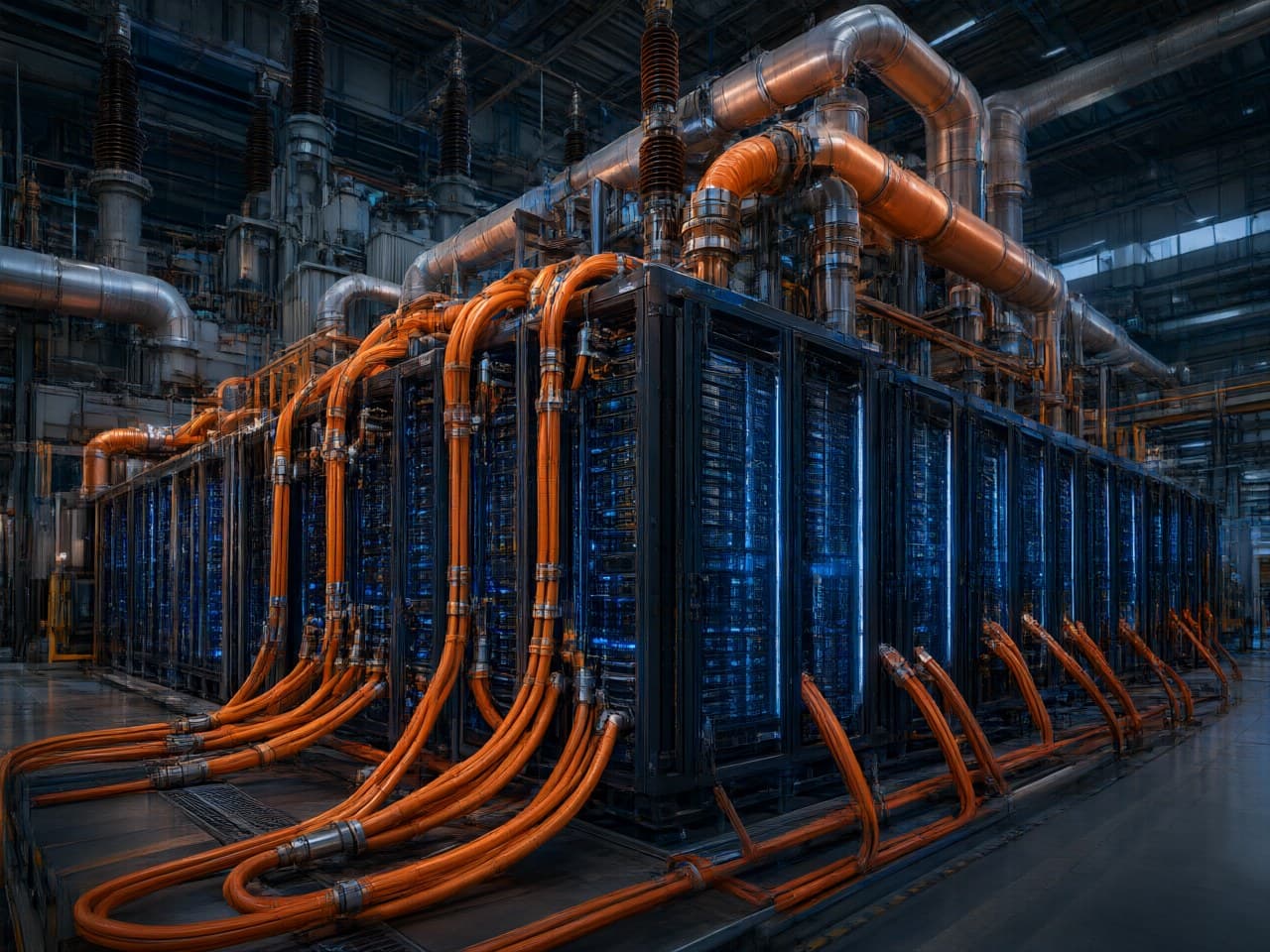
Beyond the long-term operational savings, the shift to 800 V offers massive, immediate upfront capital savings in raw materials. Safely pushing 1000 A at 400 V requires massive, expensive bundles of thick copper cabling. Halving that current means the facility can switch to much thinner conductors, reducing the total copper weight and wiring costs by roughly 50%.
Furthermore, because the cables are no longer generating that extra 15 kW of wasted heat, the facility’s air conditioning and liquid chilling systems don’t have to work nearly as hard, slashing indirect cooling costs and further shrinking the facility’s overall carbon footprint.
Cooling effects of solid-state transformers One technology that would enable this transition is smart, solid-state transformers (SSTs). Since standard magnetic transformers are too slow to react to the instantaneous load drops of an AI cluster, facilities are increasingly adopting SSTs, which use advanced power electronics to actively manage and smooth out violent power fluctuations. This transformation creates opportunities for companies that supply SiC FETs and gate drivers.
Due to massive power dissipation, cooling of servers is becoming a critical function. Heat dissipation of AI server racks—which now regularly exceed 100 kW to 300 kW per rack—has turned motor control in cooling systems into a critical engineering priority. Because cooling typically consumes up to one-third of a data center’s total energy budget and is growing, advancements in how fans and liquid pumps are throttled directly dictate facility efficiency.
Transition to a 48-V architecture Another trend in the AI infrastructure is the transition to high-efficiency 48-V power architecture by delivering scalable intermediate bus conversion solutions tailored for data centers, AI platforms, networking equipment, and industrial systems. With highly integrated DC-DC converters, digital power controllers, and intelligent power modules, customers can reduce thermal losses, improve power density, and support rapidly increasing processor and accelerator power demands. Flexible power solutions enable designers to streamline system development, optimize board space and achieve reliable, energy-efficient power delivery from 48-V intermediate buses down to core voltage rails across next-generation computing platforms.
The impact of AI on cellular networks An overlooked aspect of this transition is on the wireless infrastructure, specifically the rise of AI radio access networks (AI-RAN). Traditional cell towers are designed strictly to pass wireless signals without reading or modifying content. Under the new AI-RAN architecture, telecom companies are installing AI computing hardware directly inside cell towers to run the traditional 5G cellular network, while simultaneously using their built-in GPUs to run local AI workloads for the immediate neighborhood. This is forcing telecommunications operators to rapidly convert thousands of aging local central offices and switching hubs into neighborhood edge data centers because they already own the land, power hookups, and fiber connections.
Historically, wireless networks were engineered for “downstream” traffic (e.g., a phone downloading or streaming a heavy video file from the cloud). Now a massive shift in traffic patterns due to generative AI tools requires a massive amount of “upstream” data.
Edge devices are constantly sending heavy images, videos, audio prompts, and sensor data up to the network, requiring wireless infrastructure to balance its upload and download capacities equally. This transformation is having an effect in the increase of computing power and power consumption at the edge and fundamentally changing how software is designed, deployed, and executed. Instead of writing code for a massive, centralized cloud data center, developers must build software for a highly fragmented, distributed environment.
AI is redefining silicon design In summary, these structural changes due to AI are forcing companies to rethink their approach to silicon design and how to complement hardware and software in their product offerings, including fundamental transformation of power delivery, cooling systems, networking infrastructure and semiconductor design. Key enablers include 800-V power architectures, solid-state transformers, 48-V power systems and AI-enabled edge networks, all aimed at delivering more computing power with greater efficiency and lower operational costs.
Source
- Power Electronics News (2026-08-26) - Original article: Power Usage in AI Datacenters and its Relevance to Energy Infrastructure