
Powder Metallurgy for Electric Vehicles Market Report: Expected to Reach $4.685 Billion by 2032
Published:
This article is reposted by Newlife - MIM. All rights reserved to the original author; please refer to the "Sources" section at the end for the original link.
Powder metallurgy (PM) for electric vehicles refers to the use of metal powders and sintering processes to produce near-net-shape components used in the propulsion, energy storage, power electronics, chassis, and thermal management functions of battery electric vehicles (BEVs) and plug-in hybrid electric vehicles (PHEVs). In this context, PM encompasses a variety of manufacturing processes: traditional press-and-sinter; metal injection molding (MIM); hot isostatic pressing (HIP); rapid solidification and atomization technologies for special powders; and increasingly, additive manufacturing (AM) methods for specific high-value components, such as binder jetting and laser powder bed fusion. The EV-centric PM market includes the raw material value chain (iron-based powders, copper and copper alloys, aluminum powders, soft magnetic powders, nickel-cobalt superalloys for thermal or structural parts), the equipment and tooling ecosystem (presses, dies, sintering furnaces, debinding/HIP systems), and a tiered supply base for designing and manufacturing finished parts for electric powertrains and auxiliary systems.
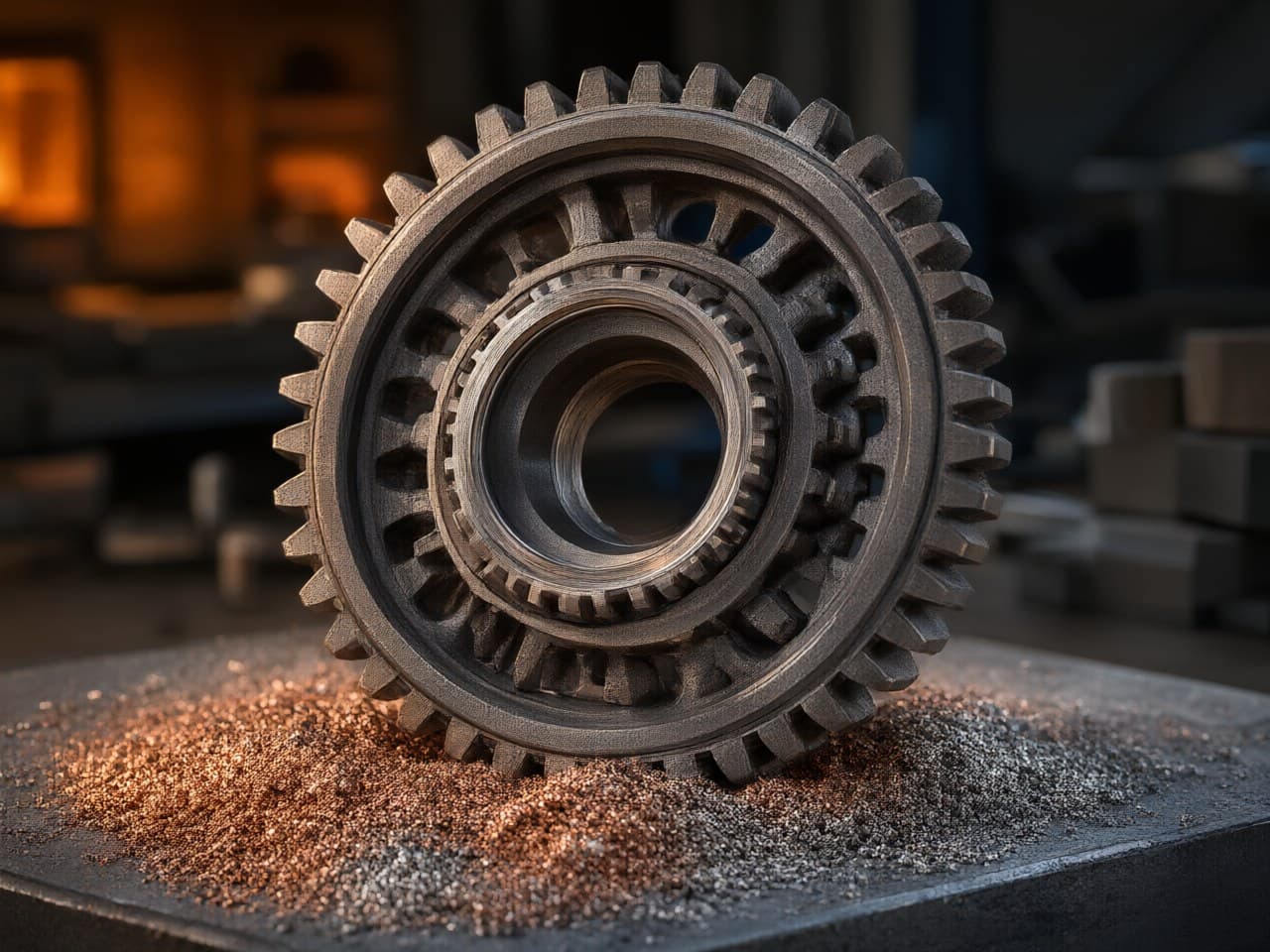
Although electric vehicles eliminate many traditional internal combustion engine (ICE) components—such as pistons, connecting rods, camshafts, and oil pumps—they introduce new components where PM is crucial. In electric powertrains, soft magnetic composites (SMC) and high-silicon iron powders are used for stator and rotor cores in certain motor topologies, especially in axial flux and high-frequency motors, due to their high requirements for 3D magnetic flux paths and low eddy current losses. PM gears and planetary carrier systems are applied in single-speed or two-speed reduction gearboxes within electric drive axles, requiring dimensional stability and high tooth strength. Self-lubricating sintered bearings and bushings are used in electric coolant pumps, AC blowers, seat and window actuators, and electric compressors. Copper-based PM components support busbars, terminals, and high-current connectors in battery packs and inverters; porous PM structures serve as thermal conductive cores and heat sinks in vapor chambers or heat pipe thermal management modules. PM of aluminum and magnesium (including AM processes) enables the manufacturing of lightweight brackets, housings, and complex cooling plates that would be difficult to produce cost-effectively via traditional machining. Beyond the powertrain, PM is also applied in chassis and body systems, such as structural brackets with integrated functions, parking brake assemblies, and sensor housings, where complex geometries, good tolerances, and cost-effective mass production are essential.
According to caifuhao.eastmoney.com, global EV PM production reached 139,000 tons in 2024, with an average selling price of USD 5,276 per ton. Global single-line capacity ranges from 3,000 to 5,000 tons per year. The industry's gross profit margin is approximately 25%-30%.
In the next few product cycles, the application of PM technology in the EV sector is expected to shift from replacing ICE components to focusing on EV-native functions. It is anticipated that SMC-based motor components will see broader deployment in specific high-frequency or axial flux applications where 3D magnetic materials excel; the use of PM gears and structural load-bearing bodies in electric drive axles will continue to grow; and as the power density of inverters and fast-charging systems increases, the adoption of PM thermal dissipation hardware may accelerate. As sintering shrinkage processes mature and production line speeds improve, binder jetting and related AM sintering processes are expected to transition from prototyping to small-batch production of copper and aluminum heat exchangers, complex brackets, and small precision parts. In terms of sustainability, powder producers that can demonstrate recycled content, low embodied carbon emissions, and closed-loop powder processing in their products will gain market favor. For buyers and engineers, the most competitive PM suppliers will be those that can act as co-design partners, integrating expertise in materials science, magnetic and thermal modeling, and design for manufacturability into early architectural decisions.
PM technology for EVs should not be viewed merely as a substitute for traditional engine components, but rather as a toolkit aligned with EV priority development directions: efficiency, compactness, quiet operation, and sustainable manufacturing. The market's definition of PM technology for EVs covers materials, processes, and applications, fully leveraging PM's advantages—near-net-shaping, controllable microstructure, and design freedom—while meeting the new demands of the EV era in magnetic materials, thermal management, and high-power-density powertrains. Its development depends on bridging technological gaps (losses, density, surface finish), scaling up green sintering processes, and integrating PM concepts into the design of motors, gearboxes, and thermal systems from the outset. As these key factors are implemented, PM technology is expected to become a significant force influencing EV cost, range, and sustainability over the next decade.
According to caifuhao.eastmoney.com, the major global producers of Powder Metallurgy for Electric Vehicles include GKN and Sumitomo Electric Industries, with the top five manufacturers accounting for approximately 40% of the global market share.
Global Market Size for Powder Metallurgy in Electric Vehicles
According to the report by caifuhao.eastmoney.com, the global market sales for EV PM reached USD 1.038 billion in 2025 and is projected to reach USD 4.685 billion by 2032, representing a compound annual growth rate (CAGR) of 28.6% (2026-2032).
Drivers
The continuous increase in global new energy vehicle production and sales, coupled with the structural growth in per-vehicle usage, is the core engine for market expansion.
As the penetration rate of new energy vehicles continues to rise in major markets such as China, Europe, and North America, the installed capacity of power batteries is expanding simultaneously. Compared to traditional ICE vehicles, new energy vehicles extensively use PM components in electric drives, battery packs, and electronic control systems, increasing the per-vehicle PM usage from the traditional 5-7 kg to over 8-10 kg. This trend of rising volume and value directly drives steady market demand expansion, providing solid incremental space for the industry.
The popularization of 800V high-voltage platforms and high-performance electric drive systems is driving technological iteration and value enhancement of PM products.
Currently, new energy vehicles are accelerating their evolution toward 800V and even higher voltage platforms, posing stricter requirements for the voltage resistance, wear resistance, and magnetic properties of core components such as motor cores and reducer gears. New powder materials like soft magnetic composites (SMC), with their low iron loss and excellent high-frequency performance, are gradually replacing traditional silicon steel sheets. This not only improves motor power density but also significantly raises the technical barriers and added value of individual products, becoming an important growth pole in the high-end market.
The integration and lightweighting trends in battery systems are reshaping the product forms and competitive landscape of PM.
With the popularization of battery integration technologies such as CTP (Cell to Pack), CTB (Cell to Body), and CTC (Cell to Chassis), battery packs face increasingly high requirements for heat dissipation, lightweighting, and structural strength. Relying on its near-net-shaping capabilities, high material utilization rate (over 95%), and ability to manufacture complex structures, PM technology shows strong substitution potential in battery brackets, cooling base plates, and thermal management components. This highly integrated and lightweight solution has become a key consideration for OEMs to improve range and reduce costs, driving the value leap of PM from single-function devices to system-level core components.
Future Development Factors
Battery system integration (CTP/CTC) and extreme thermal management needs are opening up a brand-new incremental track for copper-based and special alloy PM.
In the evolution of battery packs toward high integration, the requirements for heat dissipation efficiency and structural lightweighting have reached unprecedented levels. With its near-net-shaping capabilities, PM technology can integrally manufacture copper-based cooling base plates with complex internal cooling channels, water-cooled vapor chambers, and lightweight battery brackets. This solution, which deeply integrates structural support and efficient thermal management, perfectly addresses the pain points of next-generation battery systems, making it a key enabling technology for improving vehicle range and safety.
Breakthroughs in Metal Injection Molding (MIM) and warm compaction high-density processes are driving the evolution of chassis electronic control and precision actuators toward miniaturization and high reliability.
As the penetration rate of wire-controlled chassis (such as EPB electronic parking brakes and wire-controlled braking) and advanced driver assistance systems (ADAS) increases, there is a surge in demand for miniature, complex, and highly wear-resistant precision components. MIM and warm compaction technologies can mass-produce complex shaped parts that are difficult to achieve with traditional machining, with extremely high material utilization (over 95%) and dimensional accuracy. This process advantage not only significantly reduces system weight and assembly costs but also meets the strict requirements of intelligent chassis for high-frequency response and long life under extreme working conditions.
The industrialization of Additive Manufacturing (3D printing) technology is reshaping the R&D cycle and supply chain logic for high-end customized components.
In the rapid iteration cycle of new energy vehicles, the high cost and long cycle of traditional mold development have become bottlenecks restricting innovation. The spherical metal powders and special alloy powders required for metal 3D printing make it possible to rapidly manufacture complex fluid channels, conformal cooling molds, and lightweight topology-optimized structural parts. This technological transformation not only significantly shortens the validation cycle from concept to prototype but also provides a highly competitive commercial closed-loop for small-batch, high-value-added customized production, becoming a core transformation trend in the industry over the next decade.
Hindering Factors
The "choke point" risks in the supply chain of high-end core raw materials and key manufacturing equipment constitute the primary bottleneck restricting the industry's penetration into high-value-added fields.
Although domestic basic iron powder capacity is sufficient, high-end raw materials such as high-purity low-oxygen atomized powders and soft magnetic composites (SMC) for high-performance electric drive systems still highly rely on imports. At the same time, the import dependence for core equipment such as high-end sintering furnaces and high-speed compaction equipment remains high. This vulnerability in the underlying supply chain not only leads to severe fluctuations in raw material procurement costs but also exposes domestic enterprises to significant supply disruption risks in the face of global trade frictions, severely limiting the scaled mass production and domestic substitution process of high-end products.
The inherent physical contradiction between density and strength in traditional PM processes makes it difficult to fully match the extreme working condition requirements of core safety components in new energy vehicles.
The microscopic pores inside PM parts (the "hollow mooncake" effect) make them naturally weaker in tensile strength and fatigue life compared to dense forged steel or castings. As new energy vehicles evolve toward 800V and higher voltage platforms, the electric drive system poses extremely strict standards for the load-bearing capacity and reliability of transmission components such as gears and bearings. Traditional processes still exhibit significant fluctuations when controlling the density uniformity of large-sized parts, making it difficult to meet the rigid demands of high-end models for ultimate safety and long life, hindering the increase in penetration rate in core safety components.
Engineering challenges in material consistency and quality control severely restrict the scaled application of products in precision electronics and intelligent driving fields.
The final performance of PM products highly depends on the particle size, shape, and purity of the powders, and maintaining absolute uniformity of these parameters in mass production is extremely challenging. In the manufacturing of precision miniature components such as sensor housings and wire-controlled braking systems for new energy vehicles, even minor deviations in density or purity can lead to structural weaknesses or dimensional out-of-tolerance in sintered parts. This volatility in quality control not only increases scrap rates and production costs but also faces long certification cycles and trust barriers when PM enters the highly precision-demanding automotive electronics supply chain.
Sources
- caifuhao.eastmoney.com › web (2026-10-20) - Original link: Powder Metallurgy for Electric Vehicles Market Report: Expected to Reach USD 4.685 Billion by 2032 - https://caifuhao.eastmoney.com/news/20261021163954840744850