
Frore LiquidJet Diamond Targets 770W/cm² GPU Hotspots With Integrated Diamond Heat Spreader
Published:
Republished by Newlife - MIM. All rights belong to the original publisher; see Source below.
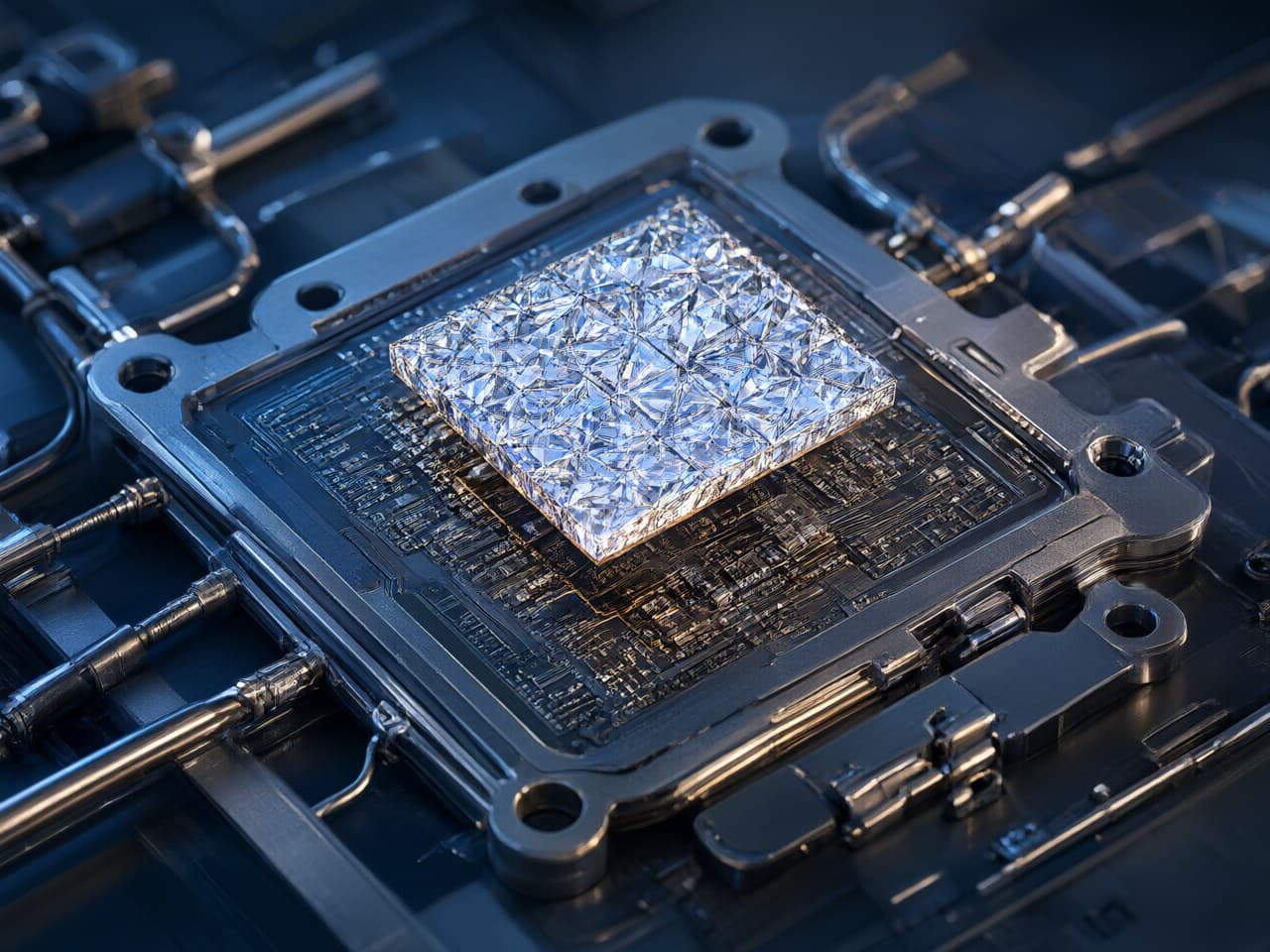
Frore Systems has introduced LiquidJet Diamond, an enhanced version of its compact liquid-cooling cold plate that integrates a diamond-based heat spreader directly above exceptionally concentrated processor hotspots. The company announced the technology on October 8, with initial specifications published on October 9. The design builds on Frore’s existing LiquidJet architecture, described as a three-dimensional, ultra-short-loop, multi-stage cold plate.
LiquidJet Diamond adds a heat-spreading layer incorporating a diamond wafer that can be positioned over the hottest part of an accelerator or graphics processor. Diamond is attractive for this application because of its exceptionally high thermal conductivity. A suitable diamond layer can distribute heat laterally before it enters the liquid-cooling structure, reducing the extreme local temperature gradients created by large AI accelerators and multi-die processors.
| LiquidJet Diamond 规格 | 公布的信息 |
|---|---|
| 产品类型 | 多阶段液冷冷板 |
| 新增组件 | 集成钻石晶圆散热片 |
| 目标应用 | AI 加速器和高功率处理器 |
| 宣称最大热点密度 | 770W/cm² |
| 宣称热点改善 | 比标准 LiquidJet 低 10°C |
| 宣称 AI 效率提升 | 10% |
Both improvements should be regarded as manufacturer claims until complete test conditions are published. GPU temperature and efficiency results depend on accelerator model, coolant temperature, flow rate, mounting pressure, thermal-interface material, workload, power limit and the exact location of the integrated diamond layer. The technology is primarily aimed at AI accelerators and other high-power computing devices rather than ordinary desktop graphics cards.
Frore has previously demonstrated LiquidJet products intended for processors consuming more than 1,400W and cooling systems designed around future NVIDIA Rubin-class accelerators. Conventional server cold plates can manage high total heat loads while still struggling with a very small region generating substantially more heat than the surrounding silicon.
Increasing the overall coolant flow is not always the most efficient response because it raises pumping requirements and can still leave a localized temperature peak. A heat spreader positioned immediately above that peak may allow the cooling system to handle it without overengineering the remainder of the cold plate. Lower hotspot temperature can also reduce leakage current and help an accelerator maintain a higher clock rate before encountering its thermal limit.
Frore has not disclosed pricing, availability, compatible accelerator packages or the expected service life of the integrated structure. It has also not published independent thermal-resistance measurements or information about how the diamond wafer affects cold-plate manufacturing costs. Consequently, LiquidJet Diamond should currently be viewed as an announced cooling technology rather than a retail PC product.
Its underlying challenge, however, is highly relevant to future GPUs: processor power is increasingly concentrated into small chiplets, compute tiles and stacked-memory interfaces where average package temperature can conceal a much hotter local region.
LiquidJet Diamond specification Announced information Product type Multi-stage liquid-cooling cold plate Added component Integrated diamond-wafer heat spreader Target application AI accelerators and high-power processors Claimed maximum hotspot density 770W/cm² Claimed hotspot improvement 10°C below standard LiquidJet Claimed AI efficiency improvement 10%
Source
- www.guru3d.com (2026-10-08) - Original article: Frore LiquidJet Diamond Targets 770W/cm² GPU Hotspots With Integrated Diamond Heat Spreader - https://www.guru3d.com/story/frore-liquidjet-diamond-targets-770w-gpu-hotspots-with-integrated-diamond-heat-spreader/