
Fixing CNC Part Size Drift with Real-Time AI Temperature Offset
Published:
Republished by Newlife - MIM. All rights belong to the original publisher; see Source below.
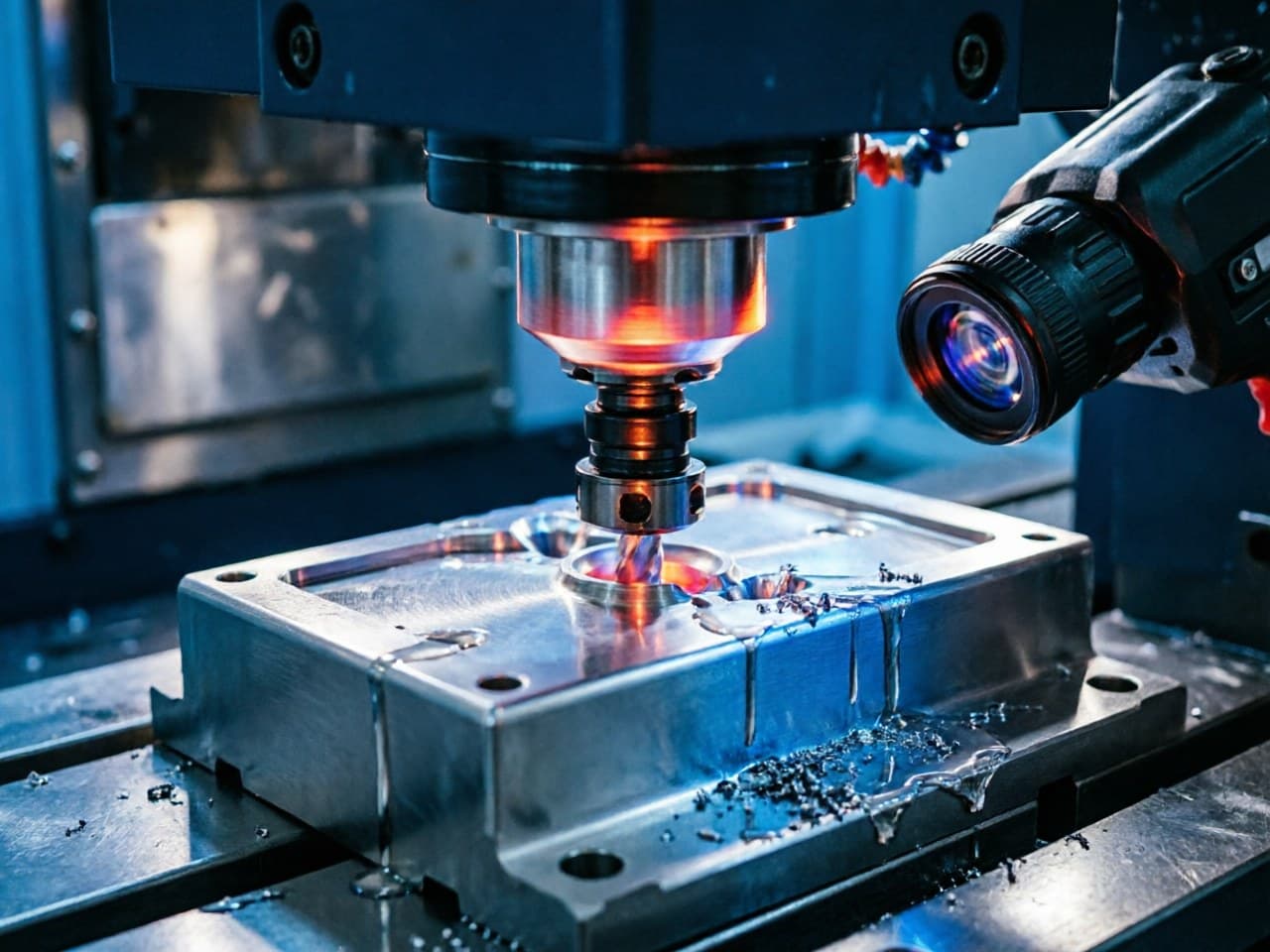
Thermal expansion within extended runs can silently destroy high-tolerance pieces. This is how thermal sensors and AI-based algorithms maintain the consistency of piece measurements throughout the run.
Most of the issues that are encountered within the quality control field during the manufacture of precision parts to high standards are not due to damaged tooling and issues in CAM programming. They are actually due to the existence of an invisible physical phenomenon known as thermal deformation.
Each machinist has experienced this: the same machine, at 8:00 AM, just after the setup, produces absolutely perfect parts. But by 2:00 PM, after hours of continuous spindle operation and ambient shop-floor temperature rises, part dimensions start creeping out of tolerance.
The Root Cause: Where Does the Heat Come From?
Thermal drift does not simply arise from one cause, it results from the complicated influence of several thermodynamic variables within the machining area
Spindle Heat Generation: Operating at speeds much faster than typical, a high-RPM spindle can easily heat to over 55°C. It’s the hot spot on a machine tool which causes expansion not just on itself, but more importantly, along its axis, namely the Z-axis.
Friction in Ball Screws and Guides: Continuous rapid positioning warms ball screws by 3°C to 8°C, subtly shifting X and Y home positions during multi-axis toolpaths.
Coolant Temperature Fluctuations: When the coolant gradually takes in the friction from the cutting the whole day long the temperature variations of as much as 10°C are able to make directly the changes of the expansion of the workpiece.
Ambient Shop Temperature: Even uncontrolled changes in ambient temperatures of only 5°C can cause a standard 1-meter steel machine bed to expand more than 55 μm.
Based on physical data about the coefficient of thermal expansion of metal, aluminum expands by approximately 23 μm per meter per °C, while steel expands by 12 μm. In a tight-tolerance setup requiring ±0.005 mm (±5 μm) precision, a thermal shift of merely 2°C is more than enough to breach critical engineering specifications.
The Old Manual Fix vs. Real-Time AI Offset
Traditionally, machine shops tackled thermal drift manually. Operators had to pause production every 2 hours, measure parts using CMM or micro-calipers, and manually update tool wear offsets in the CNC control. This trial-and-error method typically incurs a 15% to 20% loss in overall equipment effectiveness (OEE) and leaves a high risk of producing undetected scrap between sampling intervals.
Modern precision manufacturing facilities eliminate these inefficiencies by integrating dynamic predictive algorithms directly into their CNC machining services. High-precision thermal sensors feed multi-point temperature metrics into an AI algorithm that calculates structural drift in real time
Multi-Point Thermal Data Ingestion: Highly accurate RTD sensors deliver temperature readings non-stop from the main heat sources like spindle bearings, machine castings, ball screw nuts, and the surrounding air.
AI Thermal Modeling: An integrated predictive model processes live thermal inputs against trained material expansion curves and finite element analysis (FEA) data, calculating micro-level physical displacement across X, Y, and Z axes.
Dynamic Coordinate Compensation: The CNC controller automatically adds micro-adjustments to the machine coordinate system, so that structural expansion is compensated as the cutting starts on the stock material.
Instead of the manual method to adjust the machine, manufacturers are using a continuous AI-based feedback system to keep the accuracy of the dimensions within ±0.002 mm during a whole 24-hour production cycle. With this technique, not only one, but two, three, and even many manual zero setting adjustments become unnecessary during a long production run.
Real-World Impact on Precision Manufacturing
Implementing real-time AI temperature compensation delivers measurable performance improvements for critical component production across demanding industries
Over 85% Reduction in Thermal Scrap: Part rejections that are caused by shop-floor warming during the afternoon and thermal spikes during extended cutting operations are completely eliminated.
Higher Cpk Process Capability: Keeps the process capability index (Cpk) far above 1.33 during extended overnight runs even when there is no supervision, which means that very tight statistical process control is still carried out.
Batch-to-Batch Repeatability: Guarantees that part #1 and part #1,000 are performing exactly the same within the tolerance limits defined even without allowing changes by the operator or taking the system down for thermal issues.
For engineers and procurement managers sourcing critical components, choosing a manufacturing partner that implements structured thermal monitoring ensures parts fit correctly every time. Having access to these automated thermal controls, alongside complementary secondary operations like custom sheet metal fabrication, gives engineering teams complete, tight-tolerance manufacturing capabilities under one roof.
Source
- engineering.com (2026-08-13) - Original article: Fixing CNC Part Size Drift with Real-Time AI Temperature Offset - Engineering.com