
Additive Manufacturing Transforms Injection Mold Tooling
Published:
Republished by Newlife - MIM. All rights belong to the original publisher; see Source below.
3D-Printed Molds Slash Injection Molding Costs, Time
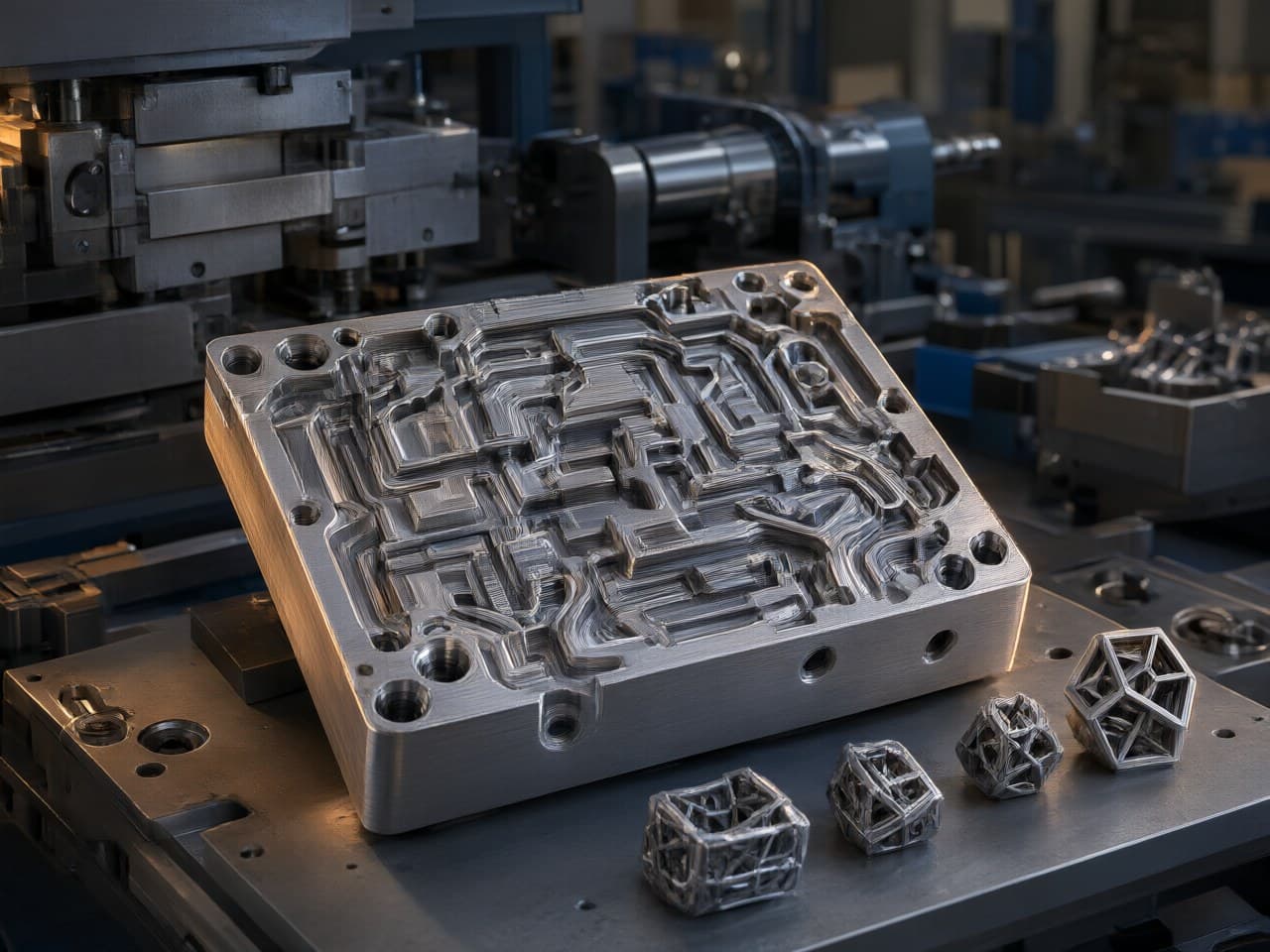
3D-printed injection molds reduce tooling costs by 80% to 90% while enabling faster iteration and validation during product development phases.
New materials and desktop printing technology are pushing additive manufacturing from prototyping into real production tooling for low-volume manufacturing.
Additive manufacturing is proving to be a money- and time-saving option in the injection mold tooling process.
Injection molding is often limited by high initial tooling costs, long lead times, and restricted geometric flexibility. However, integrating 3D-printed molds into the injection molding process allows for production of complex geometries at less cost, researchers reported in a paper published in journal Polymers titled "Integrating 3D Printing with Injection Molding for Improved Manufacturing Efficiency."
"Most of us already lived through this once with fused deposition modeling (FDM). When desktop printers got cheap enough to own, what changed wasn't the printing. It was that being wrong stopped being expensive, so people iterated instead of arguing," said Chris Buttenob, founder and partner of Radiant Product Development (Tempe, Arizona). "Printed injection tooling is the next rung, and the first one where the part comes out in the real resin."
Cost savings are well documented. IPC, the Industrial Technical Center dedicated to plastic and composite innovation in France, studied the use of 3D-printed molds for low-volume injection molding. With a mold core printed in Formlabs Rigid 10K resin and a soft frame printed in PA12, they could inject thousands of parts with polypropylene, reducing the cost of a metal mold by 80% to 90%.
"Honestly, that's the smaller number. The expensive mistake isn't the tool. It's cutting steel for a part nobody has ever seen molded. Simulation gets you close, but it doesn't hand you a part in the production resin, while the computer-aided design (CAD) is still cheap to change. That's what pulled us in. It drags the first molded part out of post-tooling and into the middle of design, which is where it actually earns its keep," Buttenob told PlasticsToday.
The promise of 3D printing has been that one doesn't have to make a mold to make a finished part. In tool and die, this can greatly shorten the path from design to tooling, according to Mike Zimmerman, a materials engineer, entrepreneur, and professor of practice in mechanical engineering at Tufts University.
"The innovation is shortening the development time of molded parts by using additive manufacturing. But the challenge is developing printable materials that can withstand the temperatures, pressures, mechanical loads, dimensional requirements, and repeated cycling required of real tooling," Zimmerman said.
Where 3D tool and die works
This approach works in two places, and they're not the same job, according to Buttenob.
"The first is at the tail end of development, when the geometry's stable enough to cut a tool but nobody's ready to spend on steel. Used there, a printed tool is an audit. Get the priorities right and it comes back asking for radius and draft tweaks. Get something important wrong and you find out for the price of a printed insert, not a steel revision. It reads fill, sink, and knit lines well. Dimension, warp, and cycle time, not so much," he said.
The second is real production, at volumes that don't pay off with a steel tool. The comparison in this case is actually machined aluminum, urethane casting, or just machining the part, and a printed insert holds its own against those, according to Buttenob.
The rule is the same, regardless. A printed tool isn't a cheap steel tool.
"It's an instrument, and it only works if you treat it like one," Buttenob said.
The catch is cosmetics, as the part wears the tool's surface.
"So, anything the user sees is out. But the structural stuff inside a housing — the brackets, standoffs, and mounts nobody ever grades on looks — is fair game. That part just has to hold its shape and take a load," he said.
The window for that is narrow.
"Published trials put polypropylene (PP) around a hundred shots at 180°C and acrylonitrile butadiene styrene (ABS) at 60 shots at 220°C, but polycarbonate (PC) at 260°C cracked the tool in four [shots]. The takeaway, in our experience, is that high-temp engineering resins are out, and so is anything glass-filled or abrasive," Buttenob said.
Next steps in innovation
3D printing's role is evolving. The molded part used to show up at the end of tooling. Now it can feed the design, Buttenob said.
Material innovation could be a game changer in the economics and performance of additive tooling, said Zimmerman, who founded Z-Polymers (Lowell, Massachusetts), developer of a material for additive manufacturing called Tullomer. Tullomer is based on a liquid crystal polymer that Z-Polymers modified to create a new structure.
"The industry is trying to make parts from a manufacturing point of view, so that it's not just prototypes, but manufacturing. And the industry is mostly focused on new printing technology to do that. The reason I started Z-Polymers is because the innovations in manufacturing history, not just additive, have been related to new material. We have a new material that can basically push additive manufacturing to make not just prototypes, but real production parts," Zimmerman said.
Z-Polymers has developed its material so that it doesn't need a very expensive printer to print it. It actually prints on a desktop printer, making the infrastructure costs (capital costs) very low.
"In plastics, in particular, people have developed high-end polymers [that require] a custom, oftentimes closed system, to print the polymer. Ours prints in a desktop printer on an open system," he said.
Generally speaking, higher-end printers can cost USD 50,000 to USD 250,000. Tullomer can print on a USD 2,000 printer, and the material costs are in line with the other high-performance polymers, according to Zimmerman.
Tullomer makes sense in tooling for prototypes, bridge tooling, low-volume manufacturing, custom products, and complex tooling, he said.
Sound practices for 3D printing in injection mold tooling
The first step, according to Zimmerman, is to understand what part of the tool you'd like to make out of a given material and to understand, up front, what stiffness, strength, temperatures, and dimensional stability are required. Then, select the material that can meet those requirements.
Two key points to keep in mind, according to Buttenob
Photopolymer is an insulator.
"Formlabs puts unfilled resin around 0.25 to 0.35 W/m K against metals north of 30, so heat doesn't leave. Cycle time climbs, and it keeps climbing across a run, which means shot 60 isn't sitting where shot five was. In a semi-crystalline resin like PP, slower cooling shifts crystallinity, and crystallinity shifts shrink. So, never quote a production cycle off a printed tool," he said.
The other point: "A printed tool won't lie about a bad corner, but it will make you pay to find out. It forces geometry you'd never ship: fat radii, extra draft, because knife edges and thin cores are the first things to go. The discipline, and this is exactly how we already run design for manufacturing (DFM), is knowing which features are design intent and which are just the tool covering itself. A bigger radius drops the stress concentration, so a corner that cracks on the printed part is going to crack in steel too," Buttenob said.
He recommended treating the molded sample as a specimen to check a model against, not a part to sign off on.
"None of this replaces the mold maker. In our shop, design and engineering already run side by side instead of in a relay, because the handoff is where intent goes to die. Printed tooling just pushes that one step further out. It puts something physical on the table to argue over while the geometry's still up for grabs," Buttenob said.
Source
- www.plasticstoday.com (2026-08-21) - Original article: Additive Manufacturing Transforms Injection Mold Tooling